Social Skills · Parenting Teens
Why Your Teenager Can't "Just Go Talk to People" — And What Actually Helps
The real reasons social confidence is harder for today's teens, and practical steps that work better than any advice you've tried.

The real reasons social confidence is harder for today's teens, and practical steps that work better than any advice you've tried.
This article is different from everything you've read about teen social struggles.
It doesn't tell you to "encourage your teen to socialize more." It doesn't suggest family therapy or screen-time limits. It doesn't blame you or your parenting.
It does something harder, and more useful: it explains what's actually happening inside your teenager's head, why the standard advice reliably backfires, and what parents who've turned this around did differently.
By the end, you'll have a clear picture of why your teen is stuck, and eight specific things you can start doing this week.
Most parents don't say it out loud. But they carry it: a quiet, low-grade fear that something is wrong with their child socially.
Not "popular" wrong. Just... okay wrong. Someone to sit with at lunch. Someone to text. Someone who would notice if they weren't there.
The worry builds from small things. The birthday party they didn't go to. The way they go silent in groups. The phone that's always in their hands, not because they're chatting with friends, but because looking at a screen is easier than looking at people.
You've tried to help. You've said the things you were supposed to say.
"Just be yourself."
"Put yourself out there."
"They'll like you once they get to know you."
Nothing changed. Or it got a little worse. Or your teen stopped talking to you about it entirely.
You're not doing anything wrong. You're working with the tools you have. The problem is that those tools weren't built for what teenagers are navigating today.
Before we talk about what helps, let's understand what's happening inside your teenager. Not what it looks like from the outside. What it feels like from the inside.
Social anxiety in teenagers isn't shyness. It isn't introversion. It isn't "overthinking."
It's something more like this: imagine walking into a room full of people while your brain runs a threat assessment in real time. Who will notice me. What will they think. What if I say something stupid. What if nobody talks to me. What if I walk over to a group and they just go quiet.
All of that happens in about three seconds. Before your teen has even opened the door.
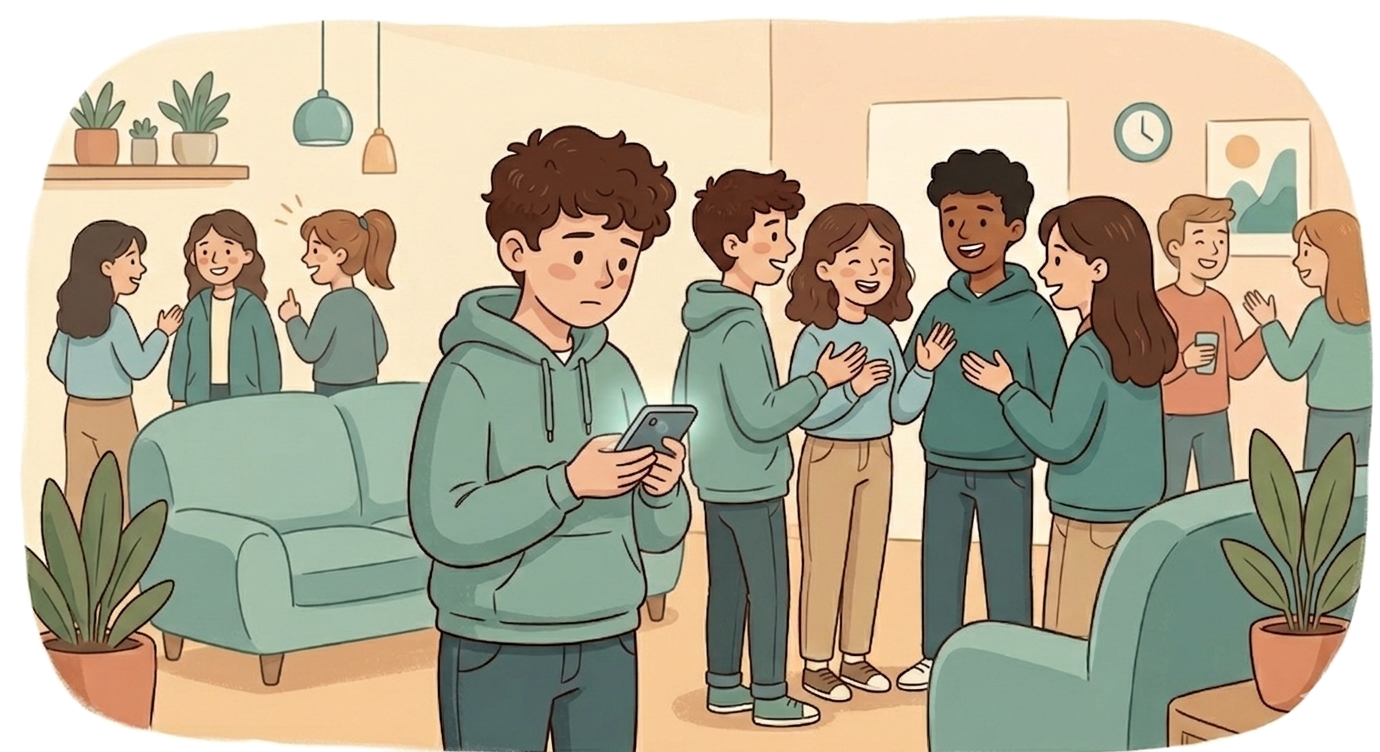
Then they walk in. They scan the room. They see groups that already know each other. They find somewhere quiet to stand. They take out their phone, not because they're bored, but because a phone gives you somewhere to look when you don't know what to do with your face.
They are not being antisocial. They are managing an overwhelming amount of internal noise with the only tool they have.
And here's what most parents don't know: your teenager probably thinks this is their fault. That they're broken. That everyone else was born with a social instinct they somehow missed.
They compare their insides to everyone else's outsides. They see confident classmates and assume those kids were just born that way. It never occurs to them that social confidence is a skill. Something learned. Something built.
Because nobody told them that.
The good news: This isn't a personality flaw. It's a skill gap. And skill gaps can be closed.
A generation ago, teenagers had more accidental practice with social interaction. You couldn't disappear as easily. You hung out outside. You called your friend's house and their parent answered. You had to navigate awkward silences because there was nothing else to do.
Today, the path of least resistance leads away from real social interaction. When something feels uncomfortable, there's a screen. When a group conversation feels too hard, there's a DM.
The result is that many teenagers arrive at 15, 16, 17 without having practiced the basic mechanics of human connection: how to start a conversation with someone new. How to keep it going past the opening line. How to sit with an awkward silence without panicking. How to join a group that's already mid-conversation.
These are learnable skills. But like any skill (reading, driving, playing an instrument), they require instruction and repetition. They don't just appear.
And here's what nobody tells parents: school was never designed to teach them. Teachers teach subjects. The social environment of school is where you're expected to apply skills you already have, not where you acquire them.
So where do most kids learn social skills? From their family. Their siblings. Their early friendships. From environments where connection was modeled and practiced, often without anyone thinking of it as "teaching."
Some kids absorb this naturally. Others don't. Not because something is wrong with them, but because they were never in an environment where it was explicitly shown. Your teenager didn't miss a gene. They missed a curriculum.
The good news: Curricula can be delivered at any age. And the teenage years, specifically, are still wide open.
It's a year from now. Your teenager comes home from school and, without being asked, sits down next to you and starts telling you about their day. Not "fine." Actual stories. A funny thing that happened. A person they talked to. You realize, sitting there, that at some point the worry you've been carrying quietly started to lift. Not all at once. Gradually. Because something shifted.
That shift is possible. And it starts with understanding what's actually in the way.
When parents realize their teen is struggling, the instinct is to help. And the advice that feels most natural is almost always the least effective.
"Just be yourself."
This tells your teen nothing about what to actually do. And for a teenager who already feels like "themselves" is the problem (too quiet, too awkward, somehow different), it lands as salt in a wound.
"Put yourself out there."
This is like telling someone learning to swim to "just float." It skips the part where you explain how. For a teen who has tried and had it go badly, it quietly confirms: I'm doing something wrong that everyone else finds easy.
"Why don't you just go talk to someone?"
This usually comes from a parent who is genuinely more socially comfortable than their teenager. To you, it sounds simple. To your teen, it sounds like: you have no idea what this costs me.
"I was shy too, and I turned out fine."
True, and irrelevant. You figured it out, probably the hard way, over years, at real cost. That cost doesn't need to be repeated.
None of this advice is malicious. It just names the destination without providing a route.
Here's what genuinely moves the needle.
This one changed everything for me personally, and it's where I'd tell every parent to start.
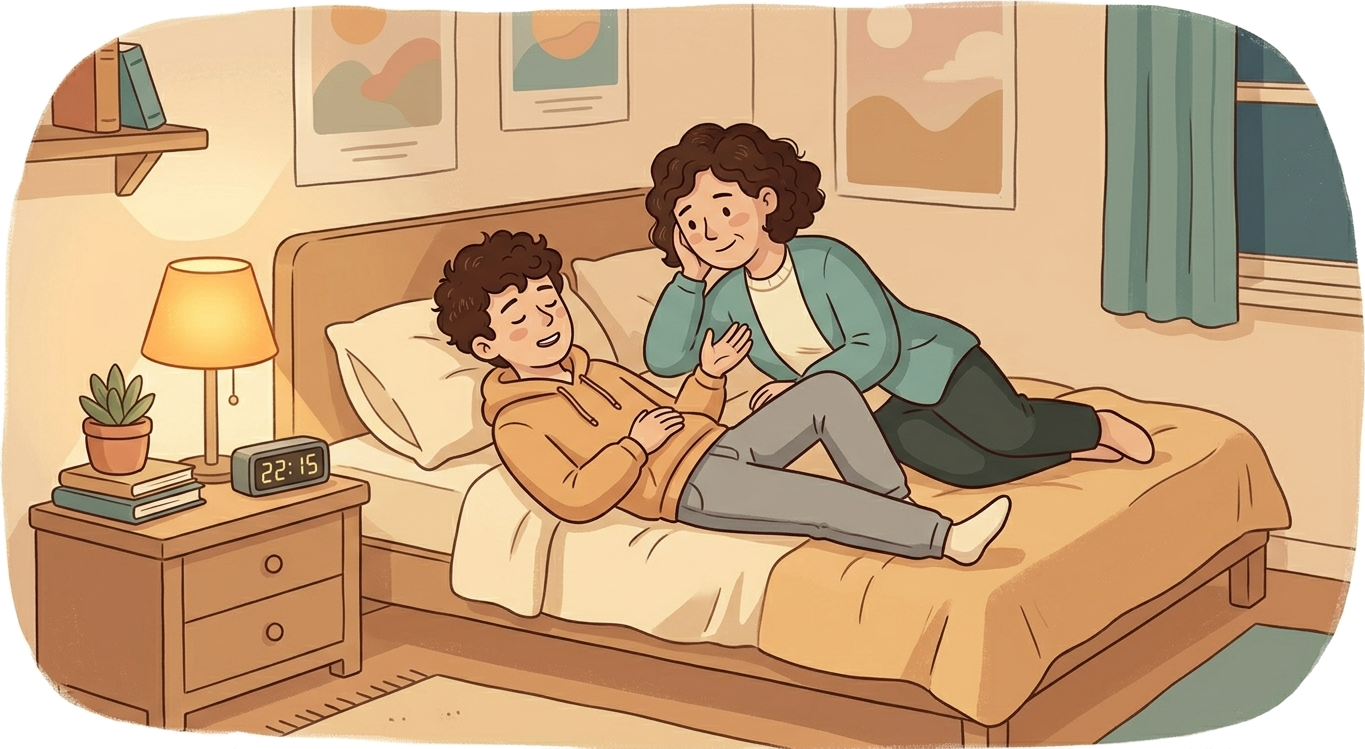
My son and I made it a ritual: every night before he went to sleep, I would lie down next to him, put my phone away, and be completely present. No agenda. No advice ready. Just there.
Sometimes we talked. Sometimes we lay in silence. Sometimes I kissed him goodnight and he fell asleep. I never pushed for conversation.
Over time, something shifted. He started opening up on his own, sharing what had happened that day, what he was thinking about, small things that mattered to him. And I listened, without jumping in to fix or advise.
Years later, that ritual is still part of our lives. If he wants silence, we're quiet. If he wants to talk, I'm there. It's the simplest thing I do, and the one that keeps the connection alive.
Five minutes. Every day. Phone away. No evaluation, no advice, no agenda.
That's where trust gets built. That's the foundation everything else rests on.
"How was your day?" invites "fine." Try questions that don't ask your teen to rate their social life:
"What was the most interesting thing anyone said today?"
"Was there anything that annoyed you?"
"Did anything funny happen?"
These open conversations without putting your teen in the position of reporting on themselves.
Share your own social stumbles, casually, without turning them into a lesson. "I ran into my colleague and completely blanked on his name for thirty seconds."
When teenagers see that adults they respect also navigate social mess, it stops feeling like proof that something is wrong with them.
"Go talk to someone" tells your teen what to do. It doesn't help with the hardest part: the first three words. Try giving them an actual phrase:
"You could say 'hey, did you understand that assignment?' and see where it goes."
A ready-made phrase dramatically reduces the mental load of starting a conversation. It gives them something to hold onto when their mind goes blank. For an anxious teenager, the mind always goes blank.
Most parents respond to outcomes: "Did you make any new friends?" But for a teenager who finds social interaction hard, the attempt itself is the achievement. Notice it:
"I saw you were the first one to go up to that person. That takes guts."
When effort gets recognized on its own, trying becomes less frightening. A failed attempt isn't failure. It's a rep.
Social skills build through repetition in environments where mistakes don't cost much. Order food at a restaurant together. Make small talk with a cashier. Call somewhere to ask a question.
These feel trivial. For a teenager who avoids all verbal interaction with strangers, they're real practice in real social mechanics.
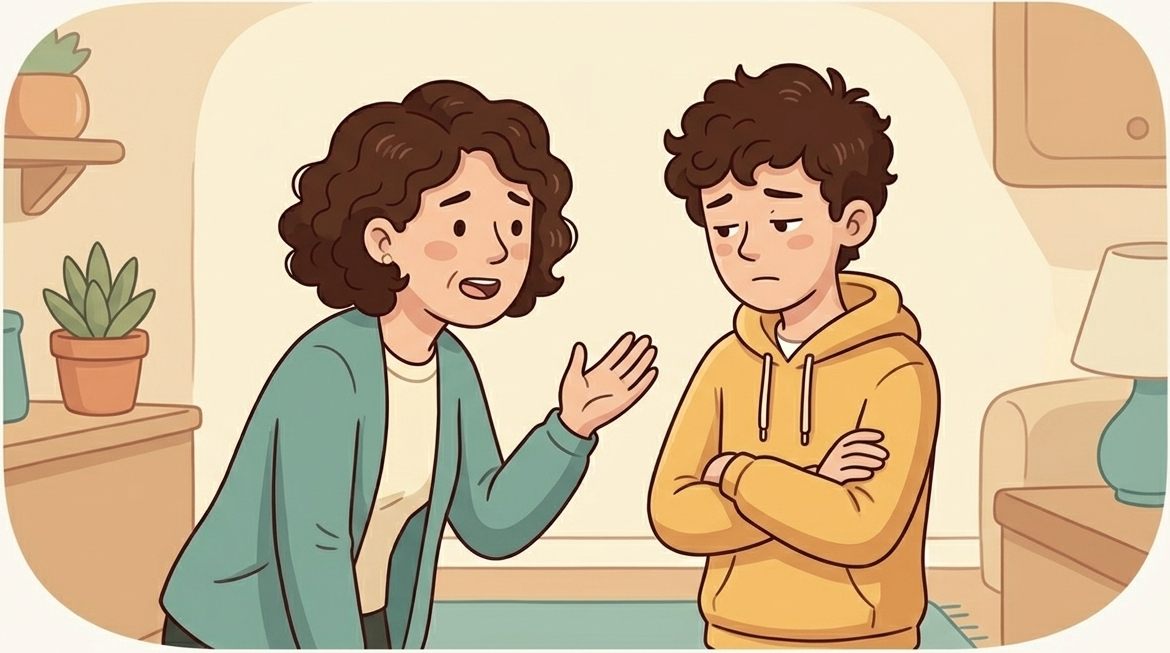
The instinct when you're worried is to have a Big Talk. These conversations rarely land well. They put your teen on the spot and usually end with "I'm fine."
Better: consistent presence in small formats. Drive them somewhere. Watch something together. Stay in their orbit without making proximity feel like intervention.
A teenager who prefers one-on-one over groups and has a friend or two they feel comfortable with is doing fine. A teenager who has nobody and avoids all social situations out of fear: that's a different pattern.
The first is a personality trait. The second is avoidance, and avoidance tends to compound over time if nothing interrupts it.
You're not trying to raise an extrovert. You're making sure that when your teenager wants to connect, they have the tools to do it.
I want to tell you something I don't say everywhere.
I was that teenager.
Not metaphorically. I ate lunch alone. I rehearsed sentences before saying them, and they still came out wrong. I spent weekends in my room not because I wanted to be alone, but because the outside world ran on social rules I couldn't decode, and I was too exhausted from trying to keep trying.
By 16, I stopped. I told myself I was just someone who didn't need people. I believed it for years.
It wasn't until my late twenties, after therapy, after working closely with a CBT specialist with four decades of experience helping people rebuild their relationship with the social world, that I finally understood what had happened.
I wasn't broken. I had a skill gap. An enormous one, built up over years of avoidance and reinforced by the belief that the gap was permanent.
When I learned it was closeable, and that I could close it, everything changed.
And I was furious. Furious that nobody had told me sooner. That I'd spent a decade believing I was fundamentally different from everyone else when what I actually had was a missing set of learnable skills that nobody had ever taught me.
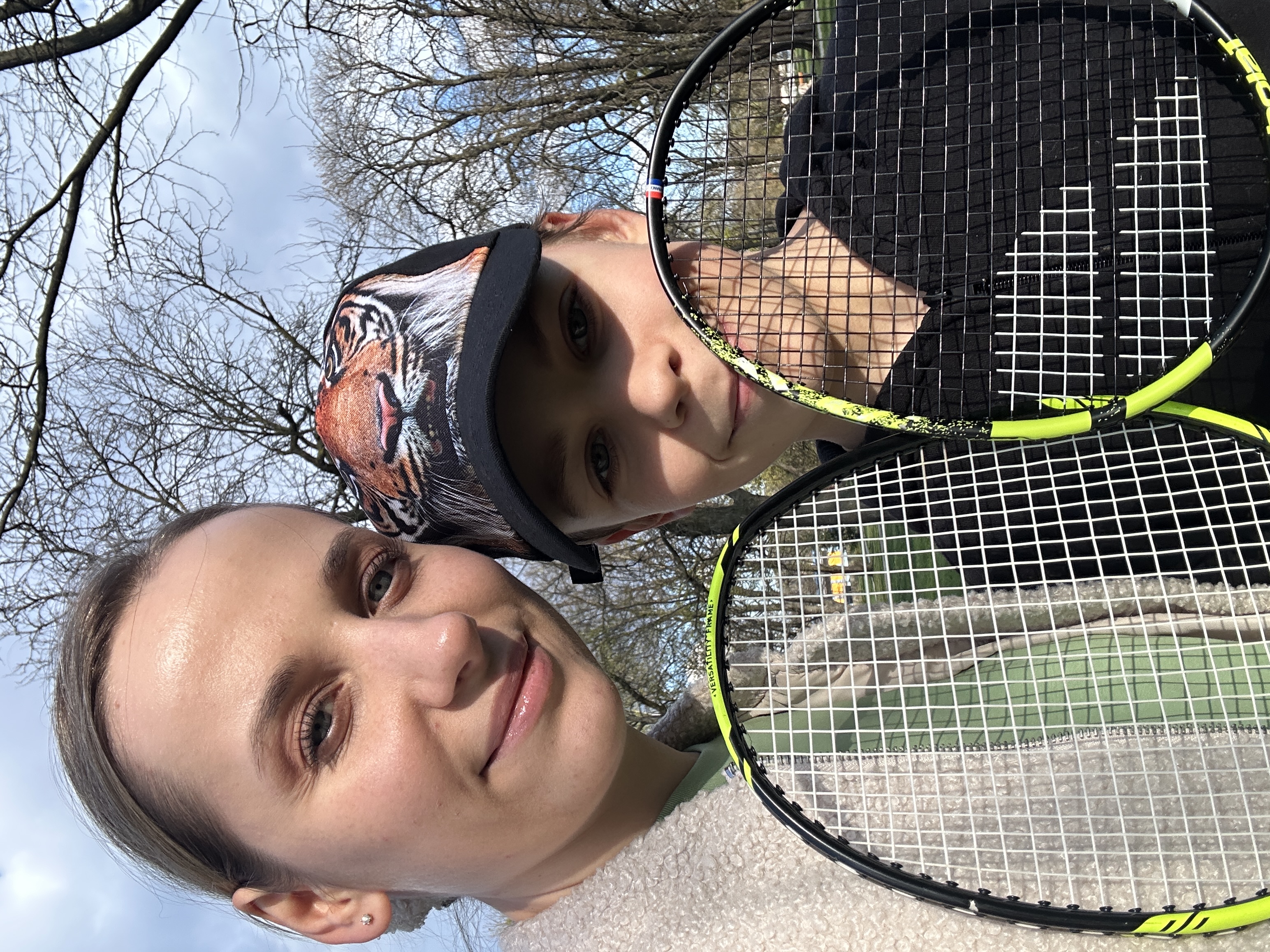
Connection looks like a lot of things. Sometimes it's tennis.
Amanda is the author of the Empowering Skills for Teens series. She writes about social confidence, financial literacy, and the skills teenagers need that nobody teaches them.
Her books have 4.8 stars on Amazon and readers in 12 countries.
Here's what I want you to know: the fact that your teenager struggles socially right now doesn't tell you anything about who they'll be. It tells you they're missing a set of tools. That's all. Tools can be given. Skills can be built. The window is open, and it won't be open forever.
Between ages 12 and 18, your teenager's brain is in its most adaptable state. The social patterns forming right now, whether connection feels safe or threatening and what they believe they're capable of with other people, will shape their friendships, relationships, and career for decades.
This isn't meant to frighten you. It's meant to tell you: what you do now matters. And it's not too late.
Learning to start a conversation at 14 takes a few awkward tries over a couple of weeks. Learning it at 24 means fighting a decade of ingrained avoidance patterns.
The skills don't get easier to build with age. They get harder. Because every year that passes, the avoidance becomes more familiar. The loneliness becomes more habitual. The belief that "I'm just not a social person" becomes more deeply embedded.
Every month your teenager spends without these tools is another month of reinforcing the wrong story about themselves.
A few things parents tell me when I share all of this:
I hear this from nearly every parent. And nearly every one of them is surprised. My book was written specifically for teenagers who don't read: short chapters, direct language, interactive exercises. Multiple parents have told me their teen finished it in a weekend. Not because they were told to. Because they couldn't put it down.
Introversion is real and valid. But there's a difference between a teen who prefers smaller settings and a teen who avoids all settings out of fear. The first is a temperament. The second is a pattern that can be shifted. The book respects introversion: it doesn't try to turn quiet kids into extroverts. It gives them tools to choose when to engage, rather than always feeling like they have no choice but to hide.
For severe clinical anxiety, yes, therapy is important. But for most teenagers, the problem isn't clinical. It's a skill gap and a set of unchallenged beliefs. A book that teaches specific skills and addresses specific beliefs can accomplish in weeks what years of vague "just put yourself out there" encouragement never does. And if therapy is part of the picture, this book is a natural companion: it gives them concrete tools to practice between sessions.
Maybe. But how long did it take you? How many friendships didn't happen? How many opportunities did you miss because you weren't sure how to show up? The fact that you survived doesn't mean your teenager needs to go through the same years of struggle, especially when there's a clear, practical alternative.
A year from now, your teenager will be somewhere.
If nothing changes, they'll probably be in a familiar place: still avoiding the hard social situations, still reaching for the phone when things get uncomfortable, still quietly believing that confident, connected kids were just born that way. And they weren't.
That belief gets harder to dislodge with every passing month. Not because it's true. Because repetition makes it feel true.
The teenage years are the window. Not the only window. But the easiest one, by far.
Your teenager, not next year or in five years but in a few months, walks into a room and doesn't immediately reach for their phone. They find someone to talk to. It's awkward for a minute and then it isn't. They come home and tell you about it. You realize you haven't worried about them in a while. Not because you stopped paying attention. Because there's less to worry about.
That's not a fantasy. That's what happens when a teenager gets the right tools at the right time.
What readers are saying
Insight and exercises teens can immediately put into practice
"This is more than just a book about 'talking better.' It's about helping teens embrace their authentic selves, nurture self-esteem, and develop skills that will serve them for life. A must-read for teens and highly recommended for parents or educators who want to support them."
Elgin · Verified Purchase
The skills and tools provide all that's required as one starts going forward in life!
"It was very helpful to my grandson, who is 13. He enjoyed the parts we read together. I like that it includes confidence-boosting exercises and positive visualisations. Skills that work for most adults too, so it's good to see them in this book."
Riley · Verified Purchase
A Valuable Guide for Teens and Parents
"It's not just a collection of tips but a well-structured toolkit that helps teenagers, step by step, build confidence and overcome social anxiety. What stands out is the combination of practical exercises, real-life case studies, and reflection questions that can be applied immediately in everyday life."
Amazon Customer · Verified Purchase
Everything in this article is a starting point. At some point your teenager needs something that speaks to them, in their language, about their world, without the complicated dynamics of a parent trying to help.
That's why I wrote Social Skills for Teens. It opens by showing them that 70% of their peers experience exactly what they're experiencing. So before anything else, a teenager reading it feels seen. Not broken. Seen.
A teacher bought 52 copies for her school. A 14-year-old came home with her first real friend after reading it over the weekend.
Get Social Skills for Teens on Amazon →Practical tools teenagers actually use — written for them, not at them.
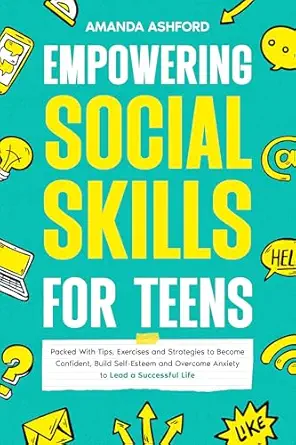
How to start conversations, make real friends, and navigate social situations — written for the teen who thinks everyone else finds this easy.
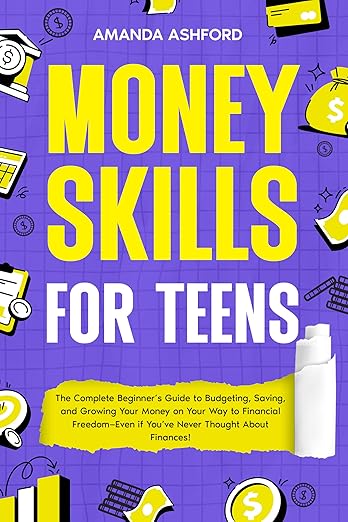
Budgeting, saving, and building a money mindset — practical financial literacy for teenagers who want to understand money before they're on their own.