New release · Launch price
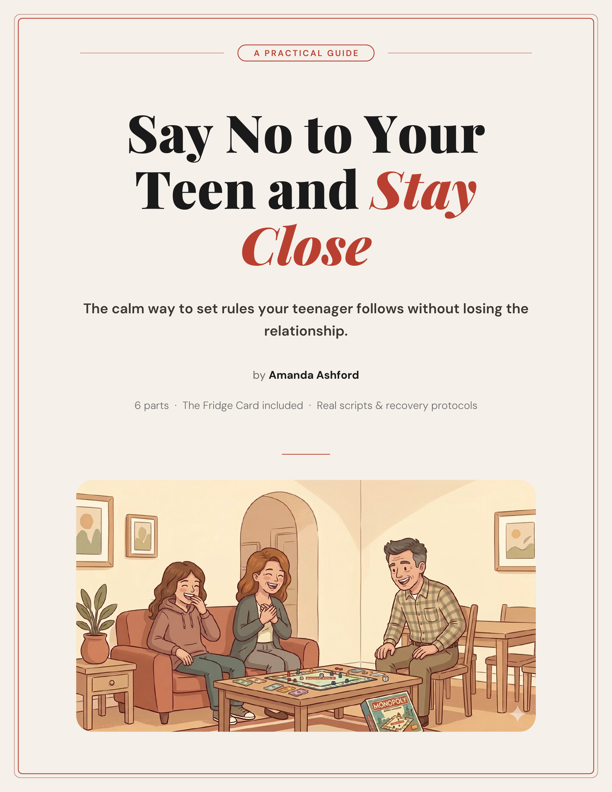
Say No to Your Teen and Stay Close
When you're tired of yelling, repeating, and punishing.
- 82-page PDF — read in one evening, use the next morning
- Real scripts for the hardest standoffs (curfew, phone, homework)
- When to hold, when to negotiate, when to let go — the Three Plans
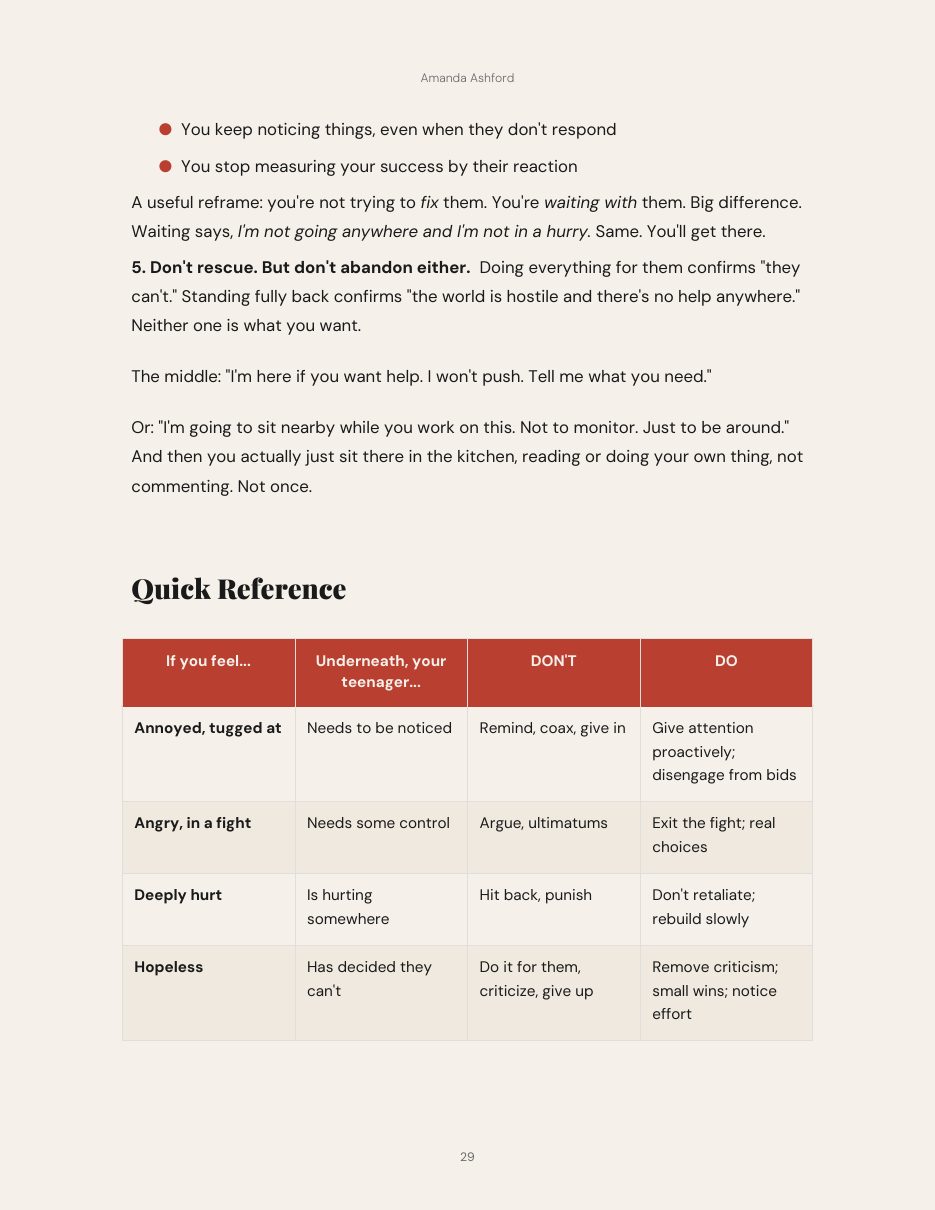
- The behavior decoder — what your teen's mood is actually asking for
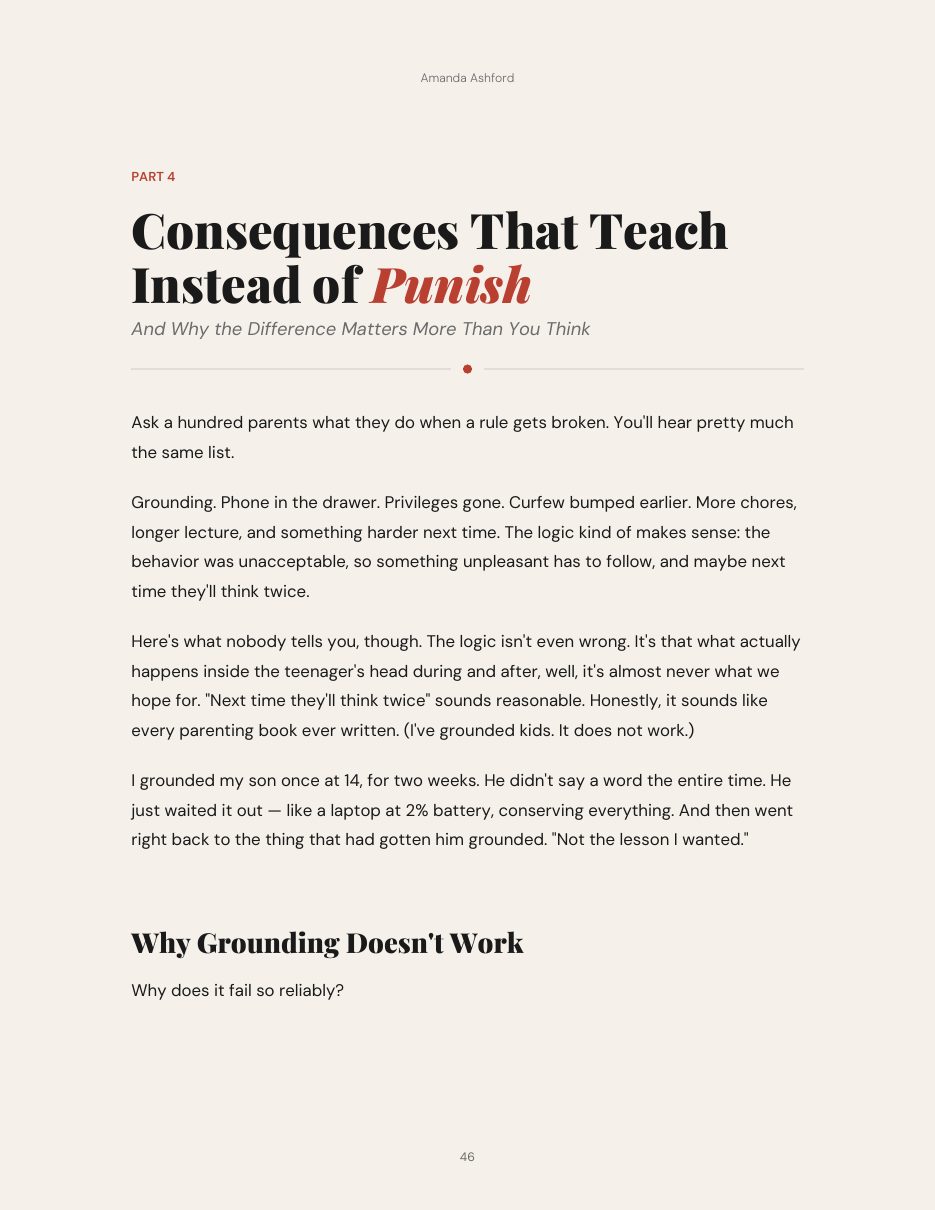
- Consequences that teach instead of punish — why grounding quit working at 13
- How to break the guilt spiral after you've snapped
- Crisis triage — when to call a professional instead
- BONUS: a printable 2-sided card — the feeling-to-need cheat sheet for when a fight starts, plus the 3-step repair for after you've lost it
$14.99
$19.99
Save $5
Get the guide →
Peek inside the guide
What's inside
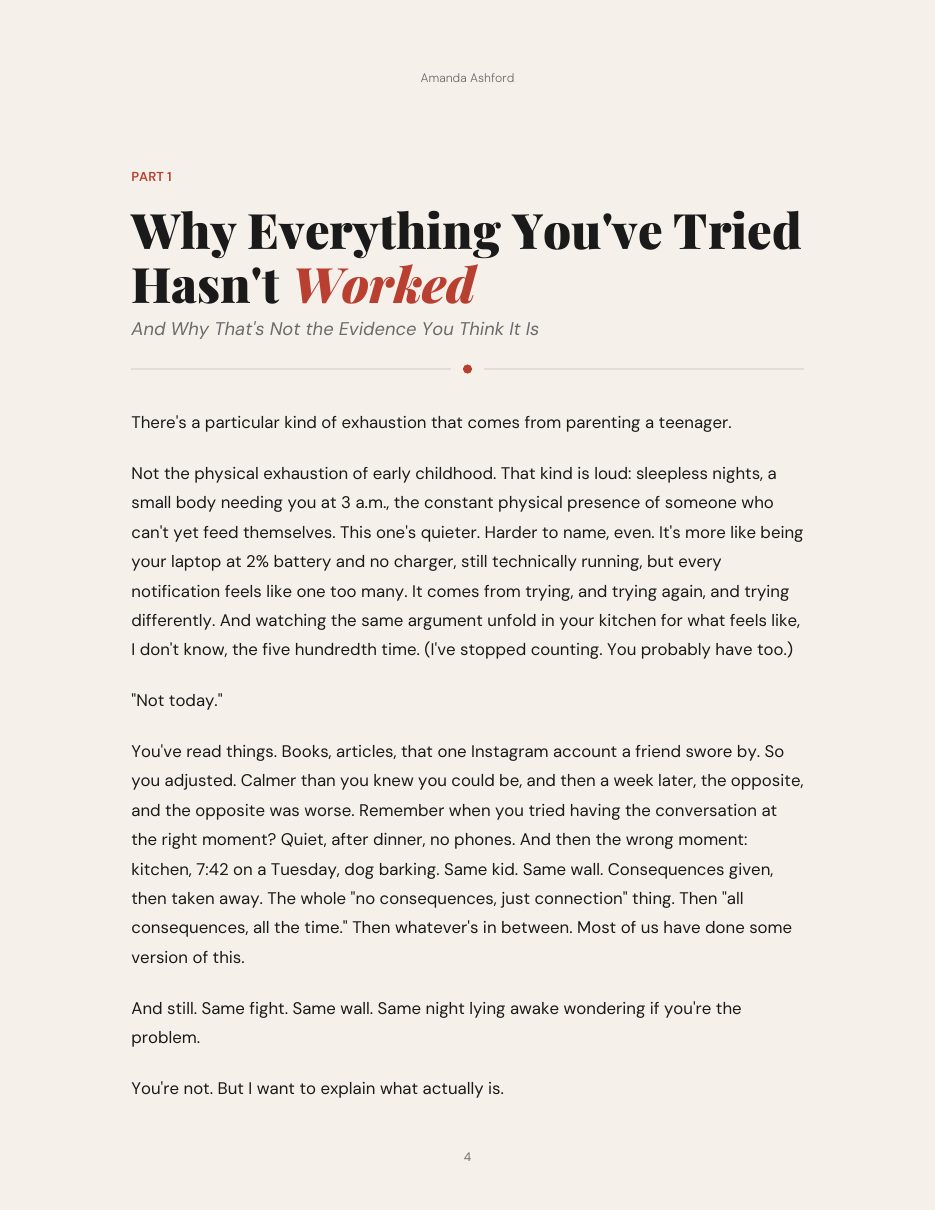
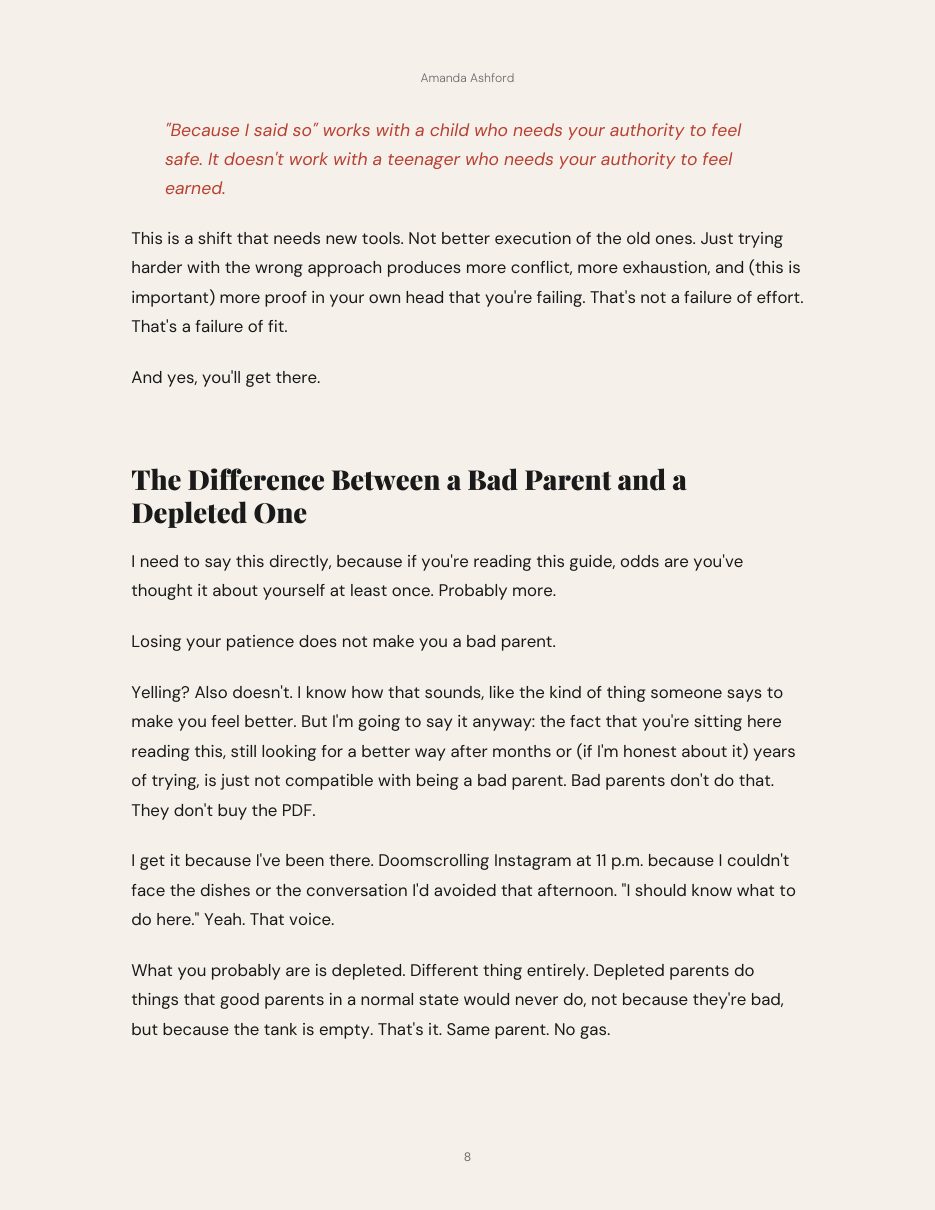
Part 1
Why everything you knew how to do stopped working
The teen brain rewires for autonomy at 12. Your old toolkit isn't broken, it just doesn't fit anymore. Includes the Depletion Check.
Part 2
What actually builds cooperation
Three styles of parenting + the diagnostic that uses your own feeling to identify what your teenager actually needs.
Part 3
Rules teenagers actually follow
A 3-step conversation framework + scripts for the three standoffs every parent knows: curfew, phone, homework.
Part 4
Consequences that teach (not punish)
Why grounding stops working at 13, and what to use instead. The three rules of effective consequences.
Part 5
When you lose it
The 30-second recovery sequence. The 3-step repair conversation. What to do with the guilt afterward.
Part 6
Beyond rules, building the culture
The small moments that build long-term respect. How to handle a co-parent who disagrees. When to bring in outside help.
The exact words, for the moments you actually live
- Ready-to-say scripts for the three standoffs every parent knows — homework, curfew, and phone — word for word.
- The 3-step conversation for setting any rule: Empathy → Define the problem → Invitation, so the rule is set with your teen, not at them.
- How to hold firm on the non-negotiables — exactly what to say when they push back on a line that doesn't move.
- What to say when they call the rule "unfair" — three ready responses that turn protest into problem-solving.
- Why the pushback gets louder before it gets quieter (the "extinction burst") — and how to stay steady through the first few weeks.
If you've ever ended a fight with your teenager and thought…
- "I sound exactly like my mother — and I swore I never would."
- "They used to listen. Now every rule turns into a war."
- "Punishments don't even work anymore. They just get more defiant."
- "I keep losing my temper and feeling guilty for hours afterward."
- "Other parents make it look so easy. What am I doing wrong?"
You're not doing it wrong. You're using tools that worked when your child was seven — on a teenager whose brain has rewired itself for autonomy. This guide is built for that specific gap.
What changes after the guide
Not a miracle. A different baseline. Slow, real, and durable.
01
The yelling stops being your default.
You learn what's happening in your nervous system in the 30 seconds before you snap. You catch yourself earlier each week. By the end, the explosion stops being how the fight ends.
02
Curfew, phone, and homework stop being wars.
You have a three-step framework for the rule-setting conversation, and exact scripts for the three standoffs every parent knows. Your teen knows what to expect. The arguments shorten or disappear.
03
Punishments start working again, because you stop using them.
You learn why grounding stops landing at 13, and what to use instead. Consequences that teach, not punish. Connected, proportionate, short. Your teen actually changes behavior, not just resents you longer.
04
You stop feeling like the villain.
Setting limits stops feeling like attacking your kid. You learn how warm-and-firm actually works in practice, so you can hold a hard line without it costing the connection.
05
The post-fight guilt cycle breaks.
When you slip (and you will), you have a three-step repair script. You stop ruminating for hours. You stop letting the guilt make your next limit softer than it needs to be.
06
The two of you stop being on opposite teams.
Rules stop being the line between you and your teen. They become something you build together. Quiet respect starts replacing the slammed doors.
Who wrote this

Common questions
Is this for parents of teens of a specific age?
Yes — it's written for parents of teenagers 12 through 17. The strategies map onto the developmental shifts that happen across all of those years.
My teenager has ADHD / anxiety. Will this still work?
Most of it, yes. The frameworks here (especially Part 2's emotional triggers and Part 5's recovery work) apply across neurodivergent teens too. But there's also a triage section at the front: if your teenager is struggling with something clinical, this guide tells you when to call a professional instead of relying on a book.
What if I'm doing this without my partner's support?
Part 6 covers exactly this. The short version: one warm-and-firm parent can buffer a lot. You don't need unanimous agreement to change the dynamic at home.
How long is the guide, and how long does it take to read?
82 pages, six short parts. Most parents finish in 90 minutes. The Fridge Card comes as a separate 2-page bonus PDF, ready to print — so you have something to use from the very first day.
What format is it? Can I read it on my phone?
PDF, optimized for both desktop and phone reading. Instant download after purchase.
Tonight is a fair guess for the next fight.
You can read this guide in 90 minutes. The Fridge Card is on page 5. You can use something from it before bedtime.
$14.99
$19.99
Launch price
Get the guide →
Already read How to Reach Your Teenager?
Or want to start with the communication piece first? See both guides →